
Cardio for Weight Loss: Effective Workouts, Exercises & Fat Burning Plans
Cardio for Weight Loss: Effective Workouts, Exercises & Fat Burning Plans
You want to lose weight, and you know cardio can help. But which type burns the most fat? How often should you do it? And why does it sometimes feel like you are working hard without seeing results? The answer lies not in doing more cardio, but in doing the right cardio strategically. Effective fat loss requires understanding how your body uses energy, matching your workout intensity to your goals, and integrating exercise with nutrition. This guide provides the complete framework.
Cardio, or cardiovascular exercise, elevates your heart rate to burn calories and improve heart health. For weight loss, the most effective approach combines High-Intensity Interval Training (HIIT) for metabolic efficiency and Low-Intensity Steady State (LISS) for sustainable calorie expenditure. Success depends on consistency, proper intensity, and a complementary nutrition plan. We will compare every major modality, provide sample plans, and explain the science so you can build a personalized, results-driven routine.
The Science of Cardio and Fat Burning
To use cardio effectively, you must understand how your body fuels movement. Your body primarily uses two energy systems during aerobic exercise: fat and carbohydrates. The proportion of each depends almost entirely on exercise intensity.
At lower intensities—like a brisk walk or gentle cycle—your body can use oxygen efficiently to break down stored fat for fuel. This is the “fat-burning zone,” often cited as 60-70% of your maximum heart rate. While the percentage of calories from fat is higher here, the total number of calories burned per minute is lower.
As intensity increases, your body demands energy faster than fat oxidation can supply it. It shifts to burning a greater proportion of carbohydrates (glycogen), which provide quicker energy. At high intensities, like sprinting, you burn almost exclusively carbs. That said, the total calorie burn per minute is significantly higher, and you create a powerful “afterburn” effect known as Excess Post-exercise Oxygen Consumption (EPOC).
EPOC refers to the elevated rate of oxygen intake after strenuous activity. Your body works to restore itself to a resting state, replenishing energy stores, repairing muscle tissue, and clearing metabolic byproducts like lactate. This process requires additional energy, meaning you continue to burn extra calories for hours after your workout has ended. HIIT protocols generate a notably larger EPOC than steady-state cardio.
So, the “best” cardio for fat loss is not a single zone but a strategic blend. LISS taps directly into fat stores and is sustainable for long durations. HIIT creates a superior total calorie deficit through high output and elevated post-workout metabolism. A balanced program leverages both.
Evaluating Cardio Modalities: HIIT vs. LISS vs. Steady-State
Choosing a cardio method is a matter of evaluating your goals, schedule, fitness level, and preferences. Below is a comparative analysis of the three primary structures.
| Criteria | High-Intensity Interval Training (HIIT) | Moderate-Intensity Steady State (MISS) | Low-Intensity Steady State (LISS) |
|---|---|---|---|
| Primary Fuel Source | Carbohydrates (Glycogen) | Mix of Carbs & Fat | Primarily Fat |
| Avg. Session Duration | 10-30 minutes | 30-60 minutes | 45-90 minutes |
| Calorie Burn (During) | Very High per minute | Moderate per minute | Lower per minute |
| Afterburn (EPOC) | Significant (Hours) | Moderate | Minimal |
| Metabolic Impact | Boosts metabolism, improves insulin sensitivity | Supports cardiovascular health | Promotes fat oxidation |
| Recovery Demand | High (Requires 24-48 hrs between sessions) | Moderate | Low (Can be done daily) |
| Best For | Time efficiency, breaking plateaus, improving fitness | Building endurance, consistent calorie burn | Active recovery, beginners, sustainable habit-building |
| Sample Activities | Sprints, battle ropes, cycling sprints | Jogging, cycling, swimming laps | Brisk walking, leisure cycling, hiking |
High-Intensity Interval Training (HIIT) involves short bursts of all-out effort followed by periods of rest or low-intensity recovery. A common structure is 30 seconds of work and 30 seconds of rest, repeated for 15-20 minutes. Its greatest advantage is time efficiency and metabolic disruption. You achieve substantial fitness gains and calorie burn in a short window. The downside is high joint stress and required recovery; performing HIIT daily often leads to overtraining and injury.
Moderate-Intensity Steady State (MISS), like a 45-minute jog at a conversational pace, is the traditional cardio approach. It builds cardiovascular endurance effectively and burns a predictable number of calories. It is less stressful on the nervous system than HIIT but requires a greater weekly time commitment to create a similar calorie deficit. Many find it meditative and sustainable.
Low-Intensity Steady State (LISS) is performed at a very manageable pace, such as a 60-minute walk. Its primary benefit is sustainability and direct targeting of fat stores. It places minimal stress on the body, allowing for frequent sessions or active recovery on rest days. For individuals new to exercise or managing joint issues, LISS provides a safe entry point. The major drawback is the considerable time needed to burn a high volume of calories.
In practice, a weekly plan should incorporate elements of each. You might schedule two HIIT sessions, two MISS sessions, and one or two LISS sessions as active recovery. This balanced approach maximizes calorie burn, manages fatigue, and promotes adherence.
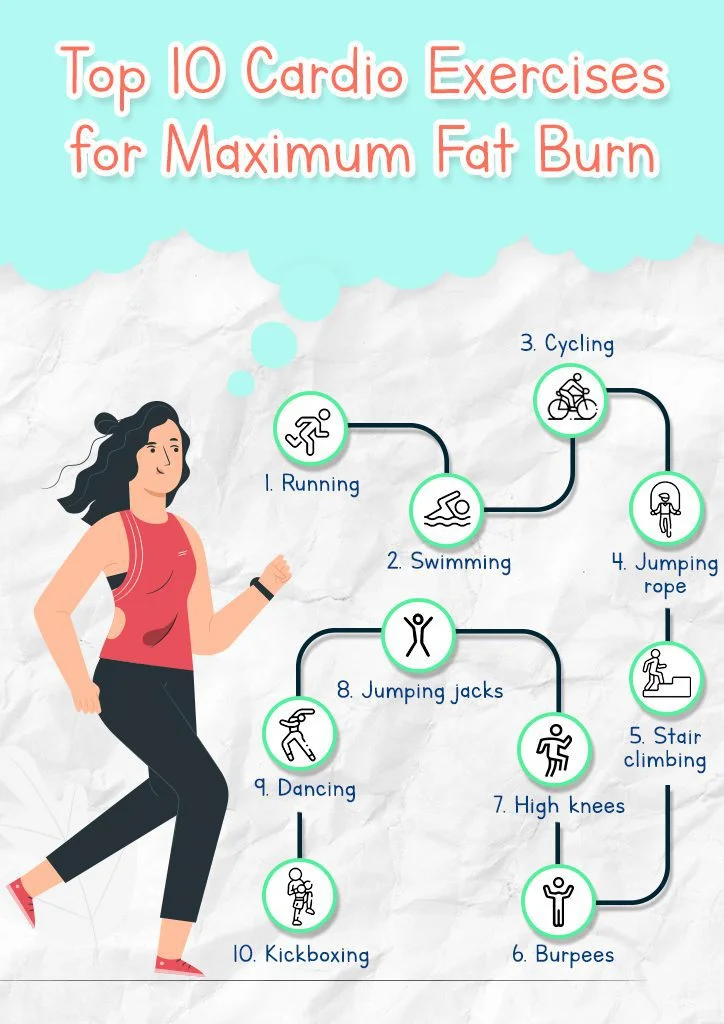
Top Cardio Exercises for Maximizing Fat Loss
The modality is the structure; the exercise is the vehicle. Your choice of activity impacts calorie burn, enjoyment, and injury risk. Here is an evaluation of the most effective exercises, ranked by average calorie expenditure for a 155-pound individual.
1. Running and Sprinting
Running remains one of the most calorie-intensive activities. At a 10-minute mile pace (6 mph), a 155-pound person burns approximately 372 calories in 30 minutes. Incorporating intervals—alternating between a sprint and a jog—can elevate this burn significantly and induce a strong EPOC effect. It requires minimal equipment but demands attention to proper form to avoid knee or shin injuries.
2. Cycling (Indoor or Outdoor)
Stationary cycling, particularly in a structured Spin class or using HIIT protocols, is exceptionally effective. A vigorous 30-minute effort can burn around 391 calories. The seated position reduces impact on joints, making it suitable for a wider population. The ability to precisely control resistance and cadence allows for targeted intensity intervals. For a detailed analysis of different machine options, our Cardio Equipment Guide provides a thorough comparison.
3. Rowing
Rowing engages approximately 85% of your body’s muscles, including the legs, core, back, and arms. This full-body demand leads to a high metabolic cost. Thirty minutes of vigorous rowing burns about 316 calories. It is low-impact and builds both cardiovascular endurance and muscular strength. Proper technique is critical to transfer power from the legs and avoid lower back strain.
4. Stair Climbing (Machine or Actual Stairs)
The stair climber machine or climbing stadium stairs is a potent lower-body workout that heavily engages the glutes, quadriceps, and calves. The vertical work against gravity yields a high calorie burn—about 335 calories in 30 minutes at a moderate pace. It elevates the heart rate quickly and is excellent for building lower-body strength and endurance.
5. Jump Rope
Jumping rope is a highly portable, high-intensity exercise. Just 15 minutes of continuous jumping can burn over 200 calories. It improves coordination, bone density, and cardiovascular fitness. It is a high-impact activity, so proper footwear and surface selection (avoid concrete) are important. It serves as an excellent warm-up or as the high-intensity component in a HIIT circuit.
6. Swimming
Swimming laps provides a no-impact, full-body workout. The water’s resistance makes it challenging, while its buoyancy protects joints. A 30-minute freestyle swim burns roughly 372 calories. It is an ideal choice for individuals with arthritis, significant weight to lose, or those seeking active recovery.
7. Incline Walking
Do not underestimate the power of walking on an incline. Setting a treadmill to a 5-10% grade and walking at 3-4 mph can burn calories at a rate comparable to jogging on flat ground, with far less joint impact. It effectively targets the posterior chain muscles (glutes and hamstrings) and is a perfect LISS or MISS activity.
The best exercise is the one you will perform consistently. Enjoyment predicts long-term adherence more than sheer calorie burn numbers. Experiment to find activities you find engaging.
Building Your Fat-Burning Cardio Plan: Sample Weekly Schedules
Theory becomes results through a structured plan. These sample schedules provide a blueprint based on different experience levels and time constraints. Always begin each session with a 5-10 minute dynamic warm-up and conclude with a cool-down and stretching.
Beginner Plan (4 sessions per week, focus on building habit)
Monday: LISS – 30-minute brisk walk (incline if on treadmill).
Wednesday: MISS – 25 minutes on the stationary bike at a consistent, moderate pace (you can hold a broken conversation).
Friday: LISS – 30-minute swim or leisure cycle.
Saturday: MISS – 25-minute incline walk (3-4% grade).
Intermediate Plan (5 sessions per week, introducing intensity)
Monday: HIIT – 20 minutes on the stationary bike. Protocol: 45 seconds sprint, 90 seconds easy recovery. Repeat 8 times.
Tuesday: MISS – 35-minute jog or elliptical session.
Thursday: HIIT – 20 minutes of bodyweight intervals (e.g., 40 seconds of jump squats, 20 seconds rest; 40 seconds of mountain climbers, 20 seconds rest; repeat circuit).
Saturday: MISS – 40-minute cycling or rowing session.
Sunday: LISS – 45-minute hike or walk.
Advanced Plan (5-6 sessions per week, maximizing output)
Monday: HIIT – Running intervals on track or treadmill. 400m (0.25 mile) sprint at 90% effort, followed by 90-second walk. Repeat 6-8 times.
Tuesday: MISS – 45-minute vigorous rowing.
Wednesday: HIIT – 30-minute Spin class or stair climber intervals (1 minute hard, 1 minute easy).
Friday: MISS – 50-minute run or swim.
Saturday: Sport or Circuit – 60 minutes of basketball, soccer, or a mixed-modal circuit workout.
Sunday: Active Recovery – 60-minute leisurely walk or gentle cycling.
Progression is key. Every two to three weeks, aim to increase the challenge. For MISS and LISS, add 5-10 minutes to your duration or slightly increase your speed/resistance. For HIIT, add one more interval to your session or reduce your rest period by 5-10 seconds.
The Critical Role of Nutrition and Recovery
Cardio creates the calorie deficit necessary for weight loss, but nutrition determines whether the weight lost comes from fat or muscle. You cannot out-exercise a poor diet.
A sustainable approach involves consuming a moderate calorie deficit—typically 300-500 calories below your maintenance needs. Prioritize protein intake (aim for 0.7-1 gram per pound of body weight) to preserve lean muscle mass during weight loss. Muscle is metabolically active tissue; preserving it keeps your resting metabolism higher. Fill the rest of your plate with fiber-rich vegetables, fruits, and whole grains for energy and satiety.
Hydration is non-negotiable. Water is essential for every metabolic process, including fat oxidation. Even mild dehydration can impair performance, reduce calorie burn, and increase perceived fatigue.
Recovery is when your body adapts and improves. Without it, you risk overtraining, injury, and burnout. Key recovery principles include:
Sleep: Aim for 7-9 hours per night. Sleep deprivation disrupts hormones like cortisol and ghrelin, increasing hunger and fat storage.
Nutrition: Consume a mix of protein and carbohydrates within 60 minutes after a strenuous session to replenish glycogen and repair muscle.
Active Recovery: Light activity like walking or stretching on rest days promotes blood flow and reduces muscle soreness.
Periodization: Schedule a lighter training week every 4-8 weeks to allow for full systemic recovery.
Monitoring Progress Beyond the Scale
The scale provides only one data point and can be misleading. Muscle is denser than fat; as you gain muscle and lose fat, your weight may stay the same while your body composition improves. Rely on multiple metrics:
Body Measurements: Track changes in your waist, hips, chest, and thighs monthly.
Clothing Fit: Notice how your clothes feel. Looser fitting garments indicate fat loss.
Progress Photos: Take front, side, and back photos every 4 weeks under consistent lighting and clothing.
Performance Metrics: Log your workout data. Can you run farther in the same time? Use more resistance on the bike? Complete your HIIT session with less fatigue? These are concrete signs of improved fitness and metabolism.
How You Feel: Note your energy levels, sleep quality, and overall mood.
Avoiding Common Cardio for Weight Loss Mistakes
Many individuals sabotage their efforts through easily corrected errors.
Mistake 1: Doing Only Steady-State Cardio. While beneficial, exclusive reliance on one pace leads to metabolic adaptation, where your body becomes more efficient and burns fewer calories doing the same workout.
Mistake 2: Neglecting Strength Training. Cardio burns calories; strength training builds the muscle that raises your resting metabolic rate. A combined approach is vastly superior for body composition.
Mistake 3: Overestimating Calorie Burn. Fitness trackers and machine readouts often overestimate calories burned by 20-40%. Do not “eat back” all your exercise calories.
Mistake 4: Ignoring Intensity. If you can easily read a book or hold a full conversation, you are likely in the LISS zone. To stimulate change, you must periodically challenge your cardiovascular system with higher intensities.
Mistake 5: Inconsistency. Sporadic, intense efforts are less effective than regular, moderate efforts. Adherence over months yields results, not perfection over days.
Integrating Cardio with a Holistic Fitness Program
Cardio is a powerful tool, but it is one component of a complete fitness strategy. For optimal body composition and health, integrate it with resistance training and mobility work.
A balanced weekly template might look like this:
Day 1: Full-Body Strength Training
Day 2: HIIT Cardio (20-25 mins)
Day 3: Active Recovery (LISS or yoga)
Day 4: Full-Body Strength Training
Day 5: MISS Cardio (40 mins)
Day 6: Sport or Fun Activity
Day 7: Complete Rest or Light Stretching
This structure ensures you develop strength, cardiovascular health, and flexibility while providing adequate recovery. Your cardio supports your fitness; your strength training protects your metabolism; your recovery enables continued progress.
Conclusion: Your Strategic Path to Fat Loss
Effective cardio for weight loss is a deliberate practice, not a random act of exercise. It requires understanding the science of energy systems, selecting the right modalities and activities for your life, and structuring a progressive plan. Remember that intensity and consistency trump duration alone. Pair your efforts with supportive nutrition, prioritize recovery, and track progress through multiple lenses beyond body weight.
The most effective plan is the one you can sustain. Start where you are, use the frameworks provided, and focus on building the habit. Consistency transforms effort into results. Your journey to a leaner, healthier, and more energetic self begins with the next step—literally. Design your plan, lace up your shoes, and begin.
Frequently Asked Questions
### How long should my cardio sessions be for weight loss?
Session length depends on intensity. High-Intensity Interval Training (HIIT) can be effective in just 20-30 minutes. Moderate-Intensity Steady State (MISS) typically requires 30-60 minutes. For Low-Intensity Steady State (LISS), aim for 45-90 minutes. Total weekly volume (150-300 minutes) matters more than any single session.
### Is it better to do cardio before or after weight training for fat loss?
For the goal of fat loss, performing cardio after weight training is generally more effective. Strength training depletes muscle glycogen, so when you begin cardio afterward, your body may tap into fat stores slightly sooner. Prioritizing weights also ensures you have maximum energy for lifting with proper form.
### Why am I not losing weight even though I am doing cardio every day?
This common plateau often stems from metabolic adaptation and imprecise nutrition. Your body becomes more efficient at the repeated exercise, burning fewer calories. You may also be unconsciously eating more. Reassess your calorie intake, change your cardio routine (add intervals, try a new activity), and ensure you are incorporating strength training.
### Can I lose weight by walking alone?
Yes, you can lose weight through walking, which is a form of LISS. Success depends on creating a consistent calorie deficit. This requires walking for sufficient duration (45+ minutes most days) and managing your diet carefully. For faster results or body composition changes, adding higher-intensity cardio and strength training is recommended.
References
– Physical Activity Guidelines for Americans, 2nd edition
– American Council on Exercise: High-Intensity Interval Training
– National Academy of Sports Medicine: The Science of Fat Loss
– Mayo Clinic: Exercise for weight loss
– Harvard Health Publishing: Calories burned in 30 minutes for different activities