
Stationary Bike vs. Elliptical: Which is Better for Your Home Gym?
Stationary Bike vs. Elliptical: Which is Better for Your Home Gym?
You want effective cardio equipment for your home, but the choice between a stationary bike and an elliptical feels like a stalemate. Both promise low-impact workouts, calorie burn, and convenience. Yet your fitness goals, physical condition, and available space demand a clear winner. The better machine is the one that aligns precisely with your primary objective, whether that is targeted leg strength, full-body engagement, joint rehabilitation, or maximizing calorie expenditure in minimal space.
This direct comparison analyzes every critical factor: biomechanical impact, muscle activation, calorie burn efficiency, space requirements, cost, and long-term usability. We will move beyond generic claims to provide actionable data, helping you invest in the tool that delivers specific results for your home gym. For a broader overview of all cardio machine categories, our comprehensive Cardio Equipment Guide offers additional context.
Understanding the Fundamental Movement Patterns
The core difference between these machines lies in their biomechanics—how your body moves against resistance. This fundamental distinction dictates which muscles work hardest and how stress is distributed across your joints.
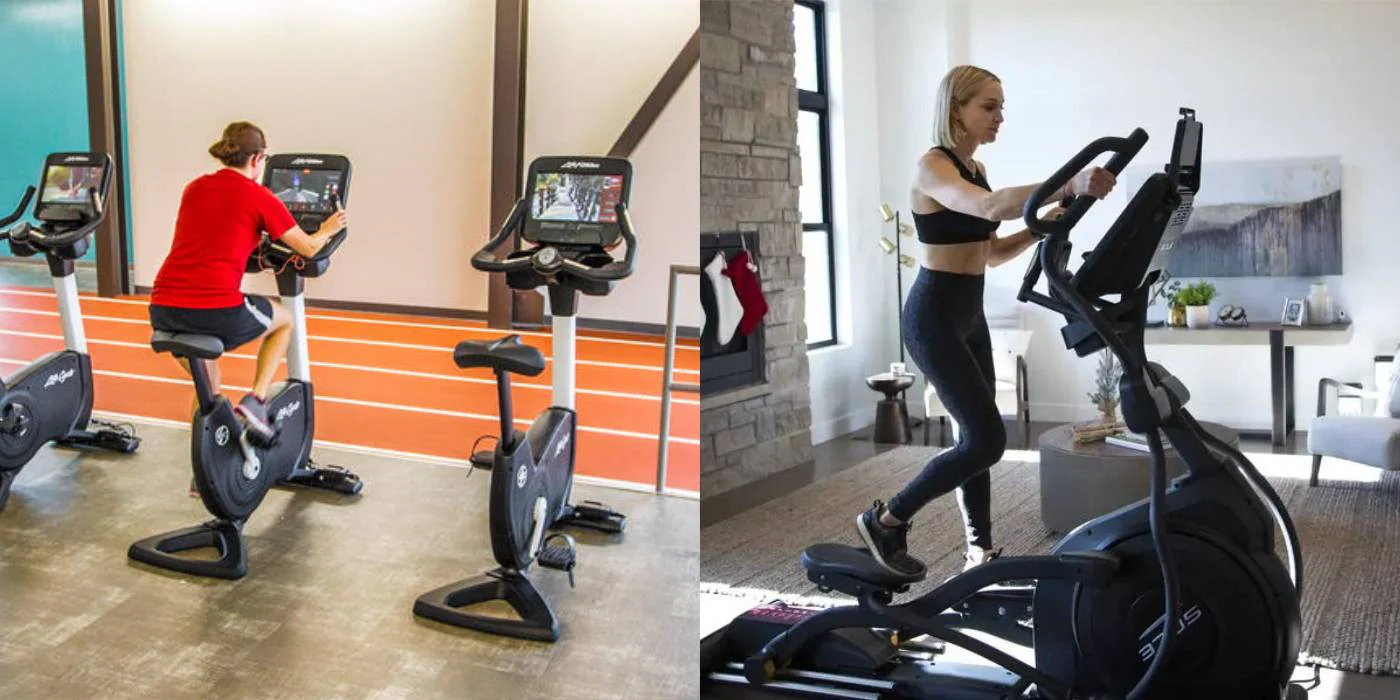
A stationary bike replicates the motion of cycling. You sit on a saddle, placing your body weight primarily on your seat bones and feet. The movement is concentric, meaning your quadriceps, hamstrings, and glutes contract to push the pedals in a smooth, circular path. Your upper body remains largely stabilized by holding the handlebars, with minimal involvement beyond maintaining posture. The motion is inherently non-weight-bearing, as the seat supports you.
An elliptical trainer, sometimes called a cross-trainer, simulates a hybrid of running, stair climbing, and cross-country skiing. You stand on two foot pedals and hold moving handlebars. The motion is elliptical or oval-shaped, creating a low-impact running gait where your feet never leave the pedals. This design engages both lower and upper body muscle groups simultaneously. The leg motion works the glutes, quadriceps, hamstrings, and calves, while pushing and pulling the handlebars activates the chest, back, shoulders, and arm muscles. The activity is weight-bearing but low-impact, as the struts absorb shock.
Comparative Analysis: Key Decision Factors
Choosing between these machines requires evaluating how each factor supports your personal situation. The following table provides a high-level summary before we explore each category in detail.
| Decision Factor | Stationary Bike | Elliptical Trainer | Key Consideration |
|---|---|---|---|
| Primary Muscle Focus | Lower body concentrated: Quads, Hamstrings, Glutes, Calves. | Full-body integrated: Legs, Glutes, Core, Chest, Back, Arms. | Do you want targeted leg conditioning or comprehensive muscular engagement? |
| Impact on Joints | Very low, non-weight-bearing. Ideal for rehab, arthritis, or significant joint concerns. | Low, weight-bearing but fluid. Good for bone density with minimal jarring. | What is the status of your knees, hips, ankles, or back? |
| Calorie Burn Potential | Moderate to high, highly dependent on workout intensity and rider effort. | Moderate to high, can be higher per session due to upper body contribution. | Maximizing burn often depends more on workout design than the machine itself. |
| Space & Footprint | Generally more compact, especially upright models. Some bikes can be stored vertically. | Larger footprint, requires more floor space and ceiling height for arm motion. | How much dedicated floor area do you have available? |
| Typical Cost Range | Wider range: $200-$4,000+. Budget options are more common. | Narrower range: $500-$3,000+. Fewer very low-end viable options. | What is your budget for a durable, effective machine? |
| Workout Variety & Boredom | High variety possible with interval programs, spin classes, and riding positions. | Moderate variety from pre-set programs, reverse motion, and adjustable incline/resistance. | Which interface and movement pattern will you adhere to long-term? |
| User Weight Capacity | Often higher; many bikes support 300-350 lbs. | Often slightly lower; many ellipticals support 250-300 lbs. | Check manufacturer specs for your specific weight. |
Detailed Evaluation by Fitness Goal
Your primary objective should drive this investment. A machine perfect for one goal may be less optimal for another.
For Weight Loss and Calorie Burn
Both machines can create a significant calorie deficit when used consistently. The critical factor is not the machine but your ability to sustain challenging, varied workouts over time. From a physiological perspective, an elliptical may offer a slight edge per identical session duration because it engages more major muscle groups. Activating the upper body increases heart rate and energy expenditure. Here’s the catch: a stationary bike, particularly an indoor cycling model, facilitates extremely high-intensity interval training (HIIT). Short, all-out sprints followed by recovery periods can elevate metabolic rate for hours post-workout. The best choice is the one you will use most intensely and frequently. For dedicated weight loss plans incorporating cardio, our resource on Cardio for Weight Loss provides structured strategies.
For Building Leg Strength and Muscle Endurance
Stationary bikes excel here. The seated cycling position allows you to apply tremendous force to the pedals, especially with a weighted flywheel and high resistance settings. This action directly targets and overloads the quadriceps, hamstrings, and glutes, building muscular strength and endurance. The ability to stand up and climb against heavy resistance on a spin bike further increases glute and calf engagement. While ellipticals work the legs, the standing, weight-bearing position and fixed path of motion limit the amount of pure resistance you can effectively handle, making it more of an endurance and toning tool than a pure strength builder.
For Rehabilitation and Joint Health
If you have knee, hip, ankle, or lower back issues, a stationary bike is often the recommended choice by physical therapists. The non-weight-bearing nature removes impact and compressive forces from vulnerable joints. The circular pedaling motion promotes range of motion and blood flow without strain. Recumbent bikes, where you sit in a bucket seat with back support, offer even greater spinal support and are ideal for those with significant back pain or mobility limitations. Ellipticals are low-impact but still require you to bear your full body weight, which can aggravate some chronic joint conditions despite the smooth motion.
For Improving Cardiovascular Health
Both are outstanding tools for cardiovascular conditioning. They safely elevate heart rate, improve stroke volume, and enhance circulatory efficiency. The elliptical may provide a more balanced cardiovascular challenge as it naturally engages the upper body, increasing overall cardiac workload. For individuals seeking to simulate the cardiovascular demand of running without the impact, the elliptical is a superior substitute. The bike is equally effective but requires more conscious effort to involve the core and upper body for a comparable whole-system challenge.
For General Fitness and Full-Body Toning
The elliptical is the unambiguous winner for a unified full-body workout. Each stride coordinates the muscles of your legs, core, chest, back, and arms. This integration improves muscular balance, coordination, and provides a more comprehensive toning effect across the entire body. A stationary bike session can be supplemented with upper body exercises, but the machine itself does not provide this combined training effect inherently.
Space, Budget, and Practical Considerations for Your Home
The ideal machine must fit your life physically and financially. Theoretical benefits are irrelevant if the equipment does not suit your home environment.
Space Requirements and Layout
Measure your available space meticulously, including ceiling height. Stationary bikes, particularly upright and indoor cycling models, have a smaller footprint, often requiring a floor area of roughly 4 feet by 2 feet. Many can be tipped and rolled or stored in a corner. Ellipticals demand more room due to their stride length and moving arms. A typical elliptical needs a space of about 6 feet by 3 feet, with additional clearance behind for safe dismount. Always account for at least a foot of buffer space on all sides. For detailed planning on integrating equipment into your home, consult our Home Cardio Gym Setup guide.
Financial Investment and Value
The market offers a vast price range for stationary bikes. You can find basic, functional models for under $300, though durability may be a concern. Mid-range bikes ($500-$1,500) from reputable brands like Schwinn, NordicTrack, and Bowflex offer excellent quality, smooth resistance, and connectivity features. High-end indoor cycles from Peloton or Stages can exceed $2,000. Ellipticals generally start at a higher entry point; a durable, smooth-stride model typically begins around $600-$800. Investing in a cheap elliptical often results in a wobbly, short-lived machine. Quality mid-range ellipticals from brands like ProForm, Sole, and NordicTrack fall between $1,000 and $2,000. Consider this a long-term investment; a higher initial cost for better construction often translates to lower cost per use over a decade.
Noise and Household Impact
Magnetic resistance bikes are virtually silent, making them ideal for apartments or homes where others may be sleeping or working nearby. Even bikes with flywheels produce only a consistent whirring sound. Ellipticals are quieter than treadmills but generate more noise due to the motion of the foot pedals, arms, and drive system. This often manifests as a rhythmic whooshing or humming. While not excessively loud, it is more audible than a bike.
User Experience and Avoiding Boredom
Adherence is the ultimate metric of success. Stationary bikes benefit from a massive ecosystem of engaging content. Services like Peloton, Zwift, iFit, and Apple Fitness+ offer immersive, instructor-led rides, virtual landscapes, and gamified training that combat monotony. The elliptical market has fewer immersive digital options, though some high-end models integrate video workouts. The elliptical’s full-body, rhythmic motion can be meditative for some but monotonous for others. Test both motions if possible; your natural preference is a powerful predictor of consistent use.
Making Your Final Decision: A Step-by-Step Guide
Follow this structured process to move from analysis to a confident purchase.
1. Define Your Non-Negotiable Priority. Is it joint protection (favoring a bike), full-body toning (favoring an elliptical), or high-intensity interval training (favoring a spin bike)? Let this primary goal anchor your decision.
2. Audit Your Physical Space. Use painter’s tape to mark the potential footprint on your floor. Ensure there is adequate clearance for safe, comfortable use.
3. Set a Realistic Budget. Include not just the machine cost, but also potential delivery fees, assembly costs, a mat to protect your flooring, and any required monthly subscriptions for interactive content.
4. Test the Movements. Visit a local fitness equipment store or gym. Spend 10 minutes on each machine. Pay attention to how your knees, hips, and back feel during and after the motion.
5. Research Specific Models. Within your chosen category, compare key specs: user weight capacity, resistance type (magnetic is preferred for quiet smoothness), stride length (for ellipticals, should match your natural gait), flywheel weight (for bikes, heavier is smoother), and warranty (look for a minimum 3-year frame, 1-year parts/ labor).
6. Plan for Integration. Decide where the machine will live permanently. Consider its visual impact, noise, and how its presence will affect your daily routine to ensure it becomes a used fixture, not ignored furniture.
Conclusion: Aligning the Tool with Your Personal Blueprint
The stationary bike versus elliptical debate resolves not with a universal champion, but with a personalized match. The stationary bike is the specialist: unparalleled for low-impact, high-intensity leg conditioning, joint rehabilitation, and space-efficient cardio. It is the tool for focused lower-body power and interval training. The elliptical is the generalist: superior for integrated full-body engagement, weight-bearing bone health, and simulating the motion of running without the associated impact. It provides a balanced, coordinated workout in a single motion.
Your optimal choice emerges from an honest assessment of your physical needs, fitness ambitions, and living constraints. Prioritize the machine that directly addresses your most important goal and fits seamlessly into your environment. Both represent excellent pathways to improved health—the most effective one is the one you will use consistently, year after year. For further guidance on selecting among all types of cardio equipment, return to our foundational Cardio Equipment Guide.
Frequently Asked Questions
Can an elliptical help build muscle like a bike does?
An elliptical builds muscular endurance and tones the full body but is less effective for building significant leg strength. The movement path limits heavy loading. A stationary bike, especially with high resistance, allows for greater force production, making it better for targeted hypertrophy and strength gains in the lower body.
Which machine is better for someone with bad knees?
A stationary bike, particularly a recumbent model, is typically recommended for significant knee issues. The non-weight-bearing motion and seated position minimize stress on the knee joint while promoting circulation and range of motion. Consult your physician or physical therapist for advice specific to your condition.
Is a more expensive machine always a better choice?
Not always, but there is a strong correlation between price and quality in home fitness equipment. Higher cost generally buys a more durable frame, a smoother drive system, a higher weight capacity, a longer warranty, and more advanced features. For frequent use, investing in a mid-range model from a reputable brand usually offers the best long-term value and experience.
Can I get a complete workout with just one of these machines?
Yes, both can serve as the cornerstone of your cardio fitness. For a complete fitness regimen, you should supplement either machine with dedicated strength training for muscle groups it underutilizes (e.g., upper body and core work if you choose a bike) and flexibility training.
References
– American Council on Exercise – Elliptical Trainer
– Harvard Health Publishing – The top 5 exercises for your health
– National Academy of Sports Medicine – Low-Impact Cardio Options
– Consumer Reports – Exercise Bike Buying Guide
– Mayo Clinic – Exercise for weight loss: Calories burned in 1 hour