
Elliptical vs. Stair Climber: Which Low-Impact Cardio Machine Is Best?
You want a serious cardio workout that does not punish your joints. Two machines dominate this space: the elliptical trainer and the stair climber. Both promise high calorie burn with low impact, but they achieve this through fundamentally different movement patterns. Choosing the wrong one can lead to frustration, boredom, or even injury. The elliptical offers a smooth, gliding motion ideal for general cardiovascular health and full-body engagement. The stair climber provides a targeted, vertical climb that builds formidable lower body strength and endurance. Your decision hinges on your specific fitness objectives, biomechanics, and how you intend to use the machine long-term.
This detailed comparison provides the data and analysis you need to make an informed choice. We will examine calorie expenditure, muscle activation, joint stress, space requirements, cost, and long-term usability. You will learn which machine excels for fat loss, which builds more leg strength, and which is more suitable for rehabilitation. This guide serves as a focused deep-dive, complementing our broader Home Cardio Equipment: The Complete Buyer's Guide & Comparison. By the end, you will know precisely which low-impact workhorse belongs in your home gym.
Understanding the Fundamental Mechanics
The core difference between these machines is not just intensity but biomechanics. This dictates everything from comfort to results.
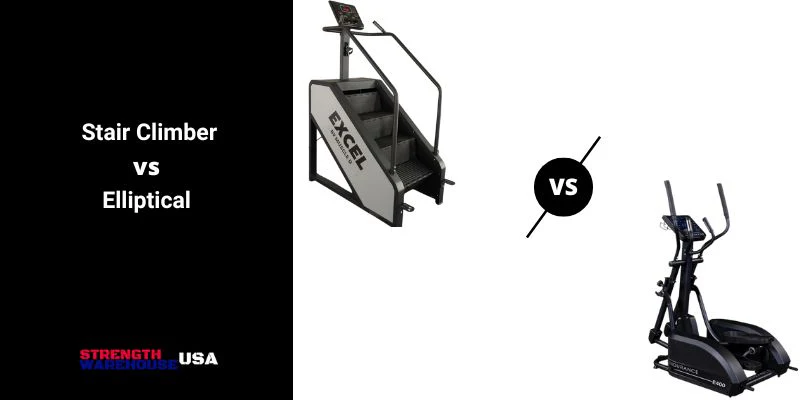
An elliptical trainer simulates a cross between running, stair climbing, and cross-country skiing. Your feet remain on large pedals throughout a continuous oval stride path. You hold onto moving handles synchronized with your legs, engaging your upper body. The motion is fluid and circular. Because your feet never leave the pedals, there is zero impact—no jarring heel strike. Most ellipticals offer adjustable resistance and incline, allowing you to alter stride difficulty and target different muscle groups. Some models can reverse motion, emphasizing hamstring and glute activation.
A stair climber, often called a step mill or stair stepper, mimics the action of climbing a continuous flight of stairs. Traditional step mills have a rotating staircase with independent steps. More common home models are mini-steppers with two foot pedals that depress against hydraulic or magnetic resistance. Your movement is purely vertical: press down with one leg to lift your body, then transfer weight to the other leg. The motion is not circular but reciprocal and piston-like. Your upper body is generally stable, holding fixed handles for balance. This creates a highly specific lower-body workout focused on the concentric (lifting) phase of each step.
Primary Fitness Goals: Which Machine Aligns With Your Aims?
Your fitness priorities should drive this decision. Each machine has distinct strengths.
For Maximizing Calorie Burn and Cardiovascular Health
Both machines provide excellent cardio. The elliptical often has a slight edge in total calorie burn for a given perceived effort because it incorporates more muscle mass. Engaging both the upper and lower body simultaneously demands more energy from your cardiovascular system. A 30-minute session can burn between 270-400 calories for a 155-pound person, depending on intensity. The motion allows for sustained, steady-state effort or high-intensity interval training (HIIT). The consistent, rhythmic nature makes it easier to maintain an elevated heart rate for extended periods, which is optimal for improving VO2 max and heart health.
The stair climber is a calorie-torching powerhouse for the lower body. It can burn a comparable 250-380 calories in 30 minutes for the same individual. The burn feels more intense locally in the legs. Because the motion is mechanically harder—you are lifting your body weight vertically with each step—your heart rate spikes quickly. This makes it exceptionally efficient for shorter, high-intensity workouts. But the localized leg fatigue may limit your total session duration compared to an elliptical. For pure cardiovascular benefit, both are outstanding; the elliptical offers more versatility in workout style, while the stair climber delivers concentrated lower-body intensity.
For Building Lower Body Strength and Muscle Endurance
This is where the stair climber dominates. The movement is a direct strength-endurance exercise for the quadriceps, glutes, calves, and hamstrings. Every step requires you to overcome resistance to lift your body weight. It is akin to performing hundreds of small, controlled leg presses or step-ups. This leads to significant muscular adaptation, improved definition, and enhanced stamina for real-world activities like hiking or climbing actual stairs. The strength gains are functional and substantial.
The elliptical also strengthens the lower body, but through a different mechanism. The resistance setting challenges your leg muscles throughout the entire circular stride, providing both concentric and eccentric (lengthening) muscle work. This can improve muscular endurance and tone. Still, the resistance levels on most ellipticals are not typically high enough to induce major hypertrophy or maximal strength gains. The elliptical builds endurance and stability across a wider range of motion. If your goal is to develop powerful, resilient legs, the stair climber is the superior tool. For balanced leg conditioning with less fatigue, the elliptical is effective.
For Full-Body Engagement and Upper Body Work
The elliptical is the clear winner for a total-body workout. The moving handles actively engage your back, chest, shoulders, biceps, and triceps. By pushing and pulling against resistance, you incorporate your upper body into the cardio effort. This not only increases calorie burn but also promotes better posture and balanced muscle development. You can choose to focus on your legs by using the stationary handles, but the option for full-body integration is a key advantage. Some users find the arm motion makes the workout feel more dynamic and less monotonous.
The stair climber is almost exclusively a lower-body exercise. Your arms and core act as stabilizers. You hold the rails to maintain balance, but this is not a strength-training activity for your upper body. Leaning heavily on the handles is a common mistake that reduces the workout’s effectiveness for the legs. For those seeking cardio that also addresses the upper body without switching equipment, the elliptical provides a distinct, time-efficient benefit.
Joint Health and Injury Considerations: A Detailed Look
Low impact does not mean zero stress. The type of stress matters greatly for those with existing conditions.
Elliptical: The Gold Standard for Joint Protection
The elliptical is often recommended by physical therapists for rehabilitation. The smooth, supported motion eliminates impact forces on the knees, hips, and ankles. The elliptical’s stride can be adjusted in length to accommodate different heights and ranges of motion, allowing users to find a comfortable, pain-free movement pattern. The ability to reverse stride can be particularly therapeutic for hamstring and glute activation without knee strain. It is an excellent choice for individuals with arthritis, recovering from joint injuries, or those who are significantly overweight and beginning their fitness journey. The risk of acute injury from use is very low.
Stair Climber: Low Impact but High Intensity
The stair climber is also low impact, as there is no jumping or pounding. However, it places significant compressive and shear forces on the knee joint, particularly the patellofemoral joint (kneecap). The deep knee bend required for each step can aggravate pre-existing knee pain, tendinitis, or meniscus issues. It is crucial to use proper form: avoid leaning forward, do not lock your knees, and ensure your knees track over your toes without collapsing inward. For those with healthy knees, the stair climber can strengthen the surrounding musculature, providing better joint stability. For those with knee problems, it can be problematic. It is generally gentler on the hips and ankles than running but more demanding on the knees than the elliptical.
Comparative Analysis Table: Elliptical vs. Stair Climber
| Evaluation Criteria | Elliptical Trainer | Stair Climber (Step Mill/Mini-Stepper) |
|---|---|---|
| Primary Motion | Smooth, oval-stride glide. Feet remain on pedals. | Vertical stepping or climbing. Piston-like leg action. |
| Impact Level | Zero impact. Ideal for sensitive joints. | Low impact, but high compressive force on knees. |
| Muscles Worked | Full Body: Quads, hamstrings, glutes, calves, core, chest, back, shoulders, arms. | Lower Body Focus: Quads, glutes, hamstrings, calves. Core as stabilizer. |
| Calorie Burn (30 min, 155 lb person) | 270 – 400 calories | 250 – 380 calories |
| Cardiovascular Benefit | Excellent. Sustained heart rate elevation, good for HIIT and steady-state. | Excellent. Rapid heart rate spike, efficient for shorter, intense sessions. |
| Strength Building | Muscular endurance and tone. Limited maximal strength potential. | Significant lower body strength and muscular endurance. |
| Learning Curve | Very low. Intuitive, natural motion. | Moderate. Requires balance and proper form to avoid knee strain. |
| Space Requirements | Larger footprint. Typically ~6' L x 2.5' W. Requires ceiling height for arm swing. | More compact. Mini-steppers can be as small as 2' x 2'. Step mills are larger. |
| Noise Level | Moderate. Smooth whirring or humming from drive system. | Low to moderate. Repetitive stepping sound; hydraulic models may squeak. |
| Typical Home Price Range | $500 – $3,000+ | $200 – $1,500 (mini-steppers); $2,500 – $8,000+ (commercial-grade step mills) |
| Best For | Joint rehab, full-body cardio, general fitness, longer workout sessions. | Lower body strength, high-intensity intervals, athletic training, compact spaces. |
Practical Considerations for Your Home Gym
Beyond workout quality, real-world factors determine which machine you will actually use.
Space and Footprint
Ellipticals require more dedicated space. You need room for the machine’s length, the arc of the pedals, and the full range of the moving arms. A typical home model needs an area of at least 6 feet by 3 feet. Ceiling height can also be a factor in low basements. Stair climbers, especially the popular mini-stepper models, are incredibly space-efficient. Many can fit in a corner, under a desk, or be stored in a closet. Commercial-style step mills with rotating stairs are as large as ellipticals and are rare in home settings due to size and cost. If space is your primary constraint, a quality mini-stepper is a compelling choice.
Cost and Investment
You can find functional mini-steppers for under $300. These models often have basic hydraulic resistance and simple consoles. Mid-range steppers with magnetic resistance and programs cost $400-$800. Ellipticals have a higher entry point. A decent beginner model starts around $500-$700, with robust, smooth units costing $1,000-$2,000. High-end ellipticals with advanced ergonomics and connectivity can exceed $3,000. Consider this a long-term investment. A cheaper machine that is uncomfortable will not be used. It is often wiser to invest in a higher-quality machine that provides a better experience and durability, as explored in our broader Cardio Equipment Guide: Choosing the Best Machines for Home & Gym.
Noise and Livability
Ellipticals generate a consistent, moderate noise from the flywheel and drive system. Magnetic resistance models are quieter than friction-based ones. The sound is usually a smooth whirring that can be masked with headphones or a television. Stair climbers produce a repetitive thump-thump from the pedals. Hydraulic piston models may develop squeaks. The noise is more percussive and can transmit through floors, a critical consideration for apartment dwellers. For multi-family living, an elliptical is often the quieter, more neighbor-friendly option. Our guide on How to Soundproof Your Home Cardio Gym: Apartment & Condo Solutions offers mitigation strategies for any machine.
Workout Variety and Avoiding Boredom
Adherence is the ultimate metric. The elliptical typically offers more built-in variety. Most consoles include numerous pre-programmed workouts that automatically adjust resistance and incline to simulate hills, intervals, and endurance courses. The ability to go forward and backward changes muscle focus. The inclusion of arm motion adds a cognitive element. The stair climber’s movement is more repetitive by nature. While many have programs that vary resistance, the fundamental motion does not change. Some users find this monotony challenging over time. Others appreciate the simple, meditative intensity. Your personal tolerance for repetitive motion is a key psychological factor.
User Experience and Ergonomics
Comfort dictates consistency. A machine that causes discomfort will be abandoned.
Elliptical Ergonomics
A proper elliptical should accommodate your natural stride length. Cheaper models often have a fixed, short stride that can feel choppy and unnatural, potentially causing hip discomfort. Look for a model with an adjustable stride length (or a long, fixed stride of at least 18-20 inches). The pedal positioning should keep your feet flat and comfortable. The handlebars should be at a height that allows a natural arm swing without shoulder hunching. Higher-end models feature articulating foot pedals that reduce ankle strain and improve comfort. Always test an elliptical before purchasing, if possible, to assess the feel of the stride.
Stair Climber Form and Setup
Proper form on a stair climber is non-negotiable for safety and effectiveness. Stand tall with a slight forward lean from the ankles, not the waist. Your core should be engaged. Avoid the temptation to rest your upper body weight on the handrails; this reduces the load on your legs and diminishes the workout. Your knees should track in line with your second toe, not cave inward. The step depth or resistance should be set so you can complete a full step without excessive knee bend or hip flexion. On a mini-stepper, ensure the machine is on a perfectly level, non-slip surface to prevent wobbling.
Making Your Final Decision: A Step-by-Step Guide
Follow this decision framework to choose your ideal machine.
1. Identify Your Primary Goal. Is it joint-safe general cardio (elliptical) or leg strength and power (stair climber)? Is full-body engagement important (elliptical)?
2. Assess Your Joint Health. Do you have chronic knee pain, past ACL injuries, or arthritis? If yes, the elliptical is almost certainly the safer choice. Consult a physician or physical therapist if unsure.
3. Audit Your Available Space. Measure your floor area and ceiling height. A compact mini-stepper solves severe space constraints.
4. Determine Your Budget. Set a realistic budget that allows for a quality machine, not just the cheapest option. Remember to factor in potential assembly costs.
5. Consider Your Personality. Do you need varied programs and a sense of “journey” to stay engaged (elliptical)? Or do you prefer a simple, brutal, and efficient grind (stair climber)?
6. Try Before You Buy. Visit a fitness equipment store or a local gym. Spend 10-15 minutes on each machine. Note which feels more sustainable and enjoyable.
For those also considering other modalities, our comparisons of Stationary Bike vs. Elliptical: Which is Better for Your Home Gym? and Treadmill vs. Rowing Machine: Which Burns More Calories in 2024? provide further context for your home gym ecosystem.
Integrating Your Choice into a Balanced Fitness Plan
Neither machine is a complete fitness solution. Both are primarily cardiovascular tools.
To build a balanced regimen, you must incorporate strength training for all major muscle groups. This is especially true if you choose the stair climber, as you will need to train your upper body, back, and core separately. If you choose the elliptical, you still require dedicated strength work to build bone density and metabolic muscle mass. Understanding the interplay between modalities is key; our article on Cardio vs. Strength Training for Fat Loss: The Best Balance details this synergy.
You can also use your chosen machine for different workout styles. Both are excellent platforms for High-Intensity Interval Training (HIIT), which can maximize calorie burn and metabolic conditioning in minimal time. Compare the specific approaches in HIIT vs. Aerobic Training: Which Burns More Fat in 30 Minutes?.
Conclusion
The elliptical and the stair climber are both exceptional low-impact cardio machines, but they serve different masters. The elliptical is the versatile, joint-protective all-rounder. It delivers full-body cardiovascular conditioning, is suitable for almost any fitness level, and excels in long-duration endurance work. It is the safer, more adaptable choice for those with joint concerns or who seek a total-body workout from a single machine.
The stair climber is the specialized, lower-body powerhouse. It builds formidable leg strength, muscular endurance, and burns calories through intense, focused effort. It is ideal for those with healthy knees who want to target their lower body, have limited space, or prefer shorter, more demanding sessions.
Your optimal choice is the machine that aligns with your dominant fitness goal, respects your body’s limitations, fits your living space, and—critically—is the one you will use consistently. Both will improve your cardiovascular health when used properly. Return to the parent pillar, Home Cardio Equipment: The Complete Buyer's Guide & Comparison, to see how this decision fits within the wider landscape of home fitness equipment. Make your selection with confidence, and prepare to invest in your health for years to come.
Frequently Asked Questions
Which machine is better for weight loss, elliptical or stair climber?
Both are highly effective for weight loss as they burn significant calories. The elliptical may offer a slight edge for longer, sustainable sessions that incorporate upper body muscles, leading to higher total energy expenditure over time. The stair climber’s intense leg focus can spike metabolism. Consistency with either machine, combined with proper nutrition, will drive weight loss.
Can a stair climber build big legs?
A stair climber builds exceptional muscular endurance and can increase leg definition and strength. For significant muscle hypertrophy (size), you generally need heavier, progressive resistance training like squats and lunges. The stair climber is a superb complementary tool for building lean, athletic leg muscle and stamina.
Is the elliptical or stair climber better for bad knees?
The elliptical is almost universally better for problematic knees. Its smooth, non-impact motion minimizes stress on the knee joint. The stair climber places high compressive forces on the kneecap and patellar tendon, which can aggravate existing knee conditions like arthritis or patellofemoral pain syndrome.
How long should I workout on each machine for good results?
For general cardiovascular health, aim for at least 150 minutes of moderate-intensity exercise per week. This could be 30 minutes, five days a week on either machine. For weight loss or improved fitness, 30-45 minutes of vigorous exercise most days is effective. Interval training on either machine can yield excellent results in 20-25 minute sessions.
References
– American Council on Exercise: Elliptical Trainer
– Harvard Health Publishing: Calories burned in 30 minutes for people of three different weights
– National Academy of Sports Medicine: The Biomechanics of Stair Climbing
– Arthritis Foundation: Best Exercises for Knee Osteoarthritis
– Consumer Reports: How to Buy an Elliptical
– American Heart Association: Recommendations for Physical Activity in Adults